Your AI Says “All Tests Pass” — But Do They?

If you've worked with an AI coding agent, you've seen this scene: the agent finishes a task and reports, full of confidence — "All tests pass ✅". You open the page. Blank screen. Or the API returns 404. "Pass," it turns out, sometimes just means the agent believes it passed.
This is the awkward spot AI-assisted development is in: writing code is no longer the bottleneck — acceptance is. Without watching every change and clicking through every feature yourself, how do you know what the AI delivered actually works, end to end? I made the broader case in The Last Mile of AI Is Infrastructure, Not Intelligence: the intelligence is already good enough; what's missing is exactly this kind of infrastructure.
The two common answers both fall short. Manual acceptance after every change can't keep up with an agent's output — and human eyes miss exactly the worst failures, the ones where the system claims it's fine while a critical path is quietly broken. End-to-end (e2e) tests are, in practice, a program you maintain forever: async, waits, retries, flakiness — and an agent refactoring the internals breaks them constantly. Worse, these days the tests are often AI-written too. When the player is also the referee, a green light doesn't carry much weight.
We built Duhem — an open-source holistic verification tool — because we think there's a third way. This post covers what it is, and a real bug it recently caught in our own product: one that fooled even the container's built-in health check, and that Duhem stopped before release.
Where false "passes" come from
To fix false greens, first see where they originate. Line up the common "pass" signals and a pattern emerges: each one genuinely proves something — just usually not the thing you care about:
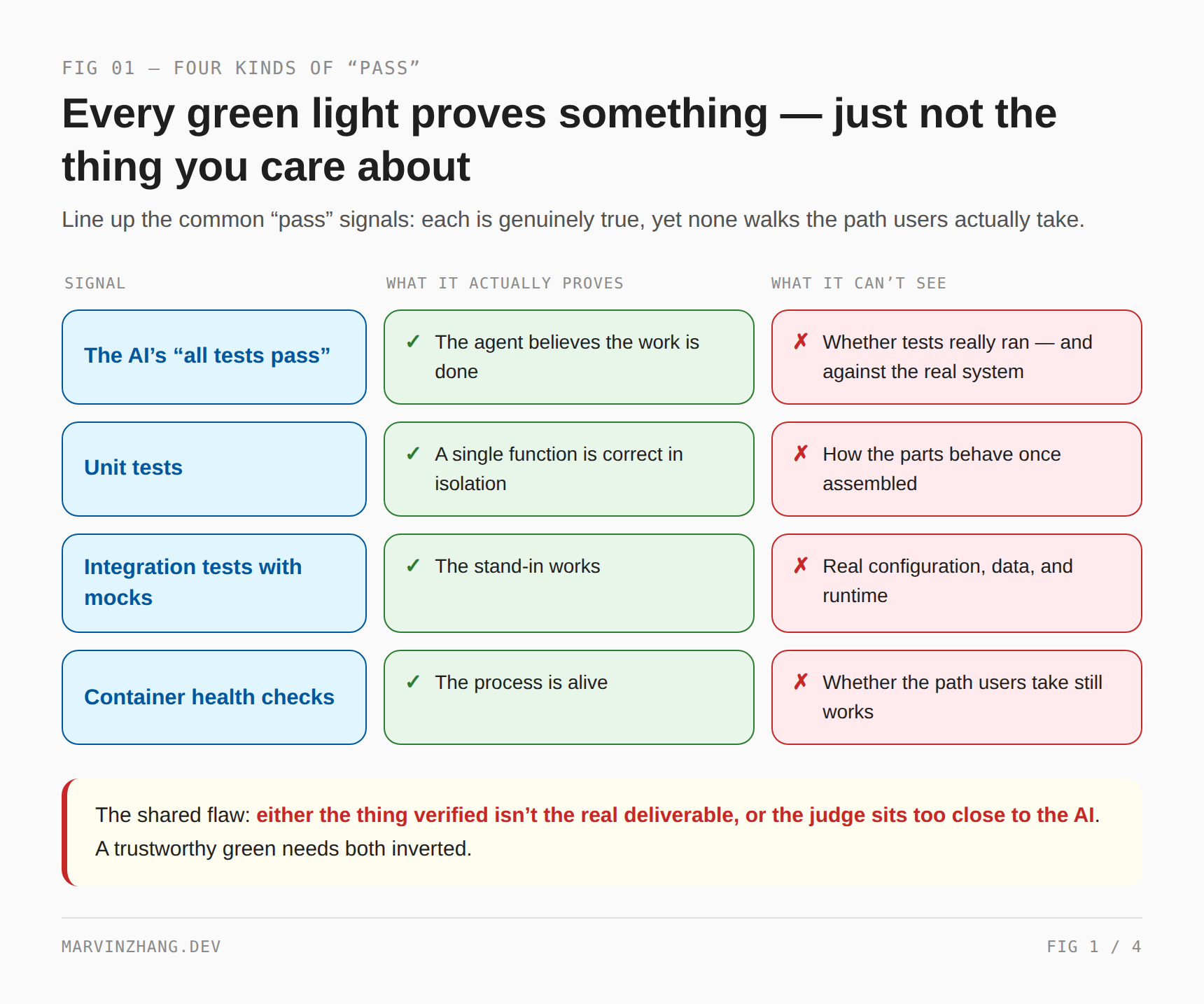
The familiar faces on this list each got their own post over the years — unit tests' limits in Talking Testing: the love and hate of Unit Tests, and the deeper boundary of automated testing in Sorry, AI Can't Save Testing: Rice's Theorem Explains Why. But the trouble here isn't that any one signal is lazy. They share a structural flaw: either the thing being verified isn't the real deliverable, or the judge sits too close to the AI. You're testing a stand-in (mocks, isolated units), or the one grading the work is the one who did it (the AI checking itself). A trustworthy green needs both inverted: verify the real system, with judgment independent of the AI.
What Duhem is
Duhem is designed around exactly those two inversions. It reads your acceptance criteria, binds them to mechanically-judged checks, drives the real deliverable through its real interfaces, and uses the deterministic verdict to decide whether the change can merge or ship.
Four design decisions set it apart:
- The spec is the test. A Verification Definition carries both things at once: human-readable acceptance criteria and machine-runnable checks. What you read, what runs, and what blocks the release are the same file — spec and implementation can't drift apart. It's Spec-Driven Development taken one step further: the spec doesn't just drive development, it drives acceptance.
- No mocks. Checks drive the real build artifact, real interfaces, real data and runtime. A green means the real system worked, not that a stand-in did.
- No AI in the verdict. An agent may help draft the criteria; a human owns them; pass/fail is computed from deterministic assertions. No model grades its own work, so there is no confident-but-wrong pass.
- You write what to verify, not the program that verifies it. Checks are anchored to intent: an agent can rewrite the internals and the check still means the same thing — no rewrite required.
One boundary worth stating plainly: Rice's theorem means no tool can prove a program "fully correct," and Duhem is no exception — its verdict says the acceptance criteria you wrote are met, not that the program is bug-free.
On disk, a Verification Definition looks like this (trimmed from Crawlab's login verification):
criteria:
  - id: AC-1
    description: Valid credentials return a usable token, and that token reaches a gated endpoint.
    checks:
      - steps:
          - id: login
            uses: api/call
            with: { method: POST, url: $inputs.login_url }
        assertions:
          - $steps.login.outputs.status == 200
The description is the human commitment; steps and assertions are the machine's actions and judgment — one file, and neither half can shake off the other.
Not another e2e testing framework
Reading "drives real interfaces", you might think: isn't this just another Playwright? Quite the opposite — Duhem's browser checks (ui/*) are driven by Playwright underneath. The two sit at different layers: Playwright is the engine and test framework you write test programs on top of; Duhem sits a layer above — you write acceptance criteria, checks derive from them, and the verdict decides whether the change can merge and ship.
A newer class of tool has emerged in the past two years: AI testing frameworks like Midscene.js. You write cases in natural language; a multimodal model understands the page at run time, finds elements, performs actions — and can even judge assertions itself (aiAssert). They solve the hard problem at the driving layer: no selectors to depend on, so UI refactors rarely break them. But the price is twofold. First, the model enters the judging loop: the same page can pass this run and fail the next, or fail confidently in the wrong direction. Second, every action and every assertion runs through a model: suites run slower than classic e2e, and the token bill is real money — put that inside a gate that fires on every build, and it compounds. The first is exactly the line Duhem won't cross: AI may draft the acceptance criteria, but the verdict must be deterministic — which, as a side effect, also cancels the second bill.
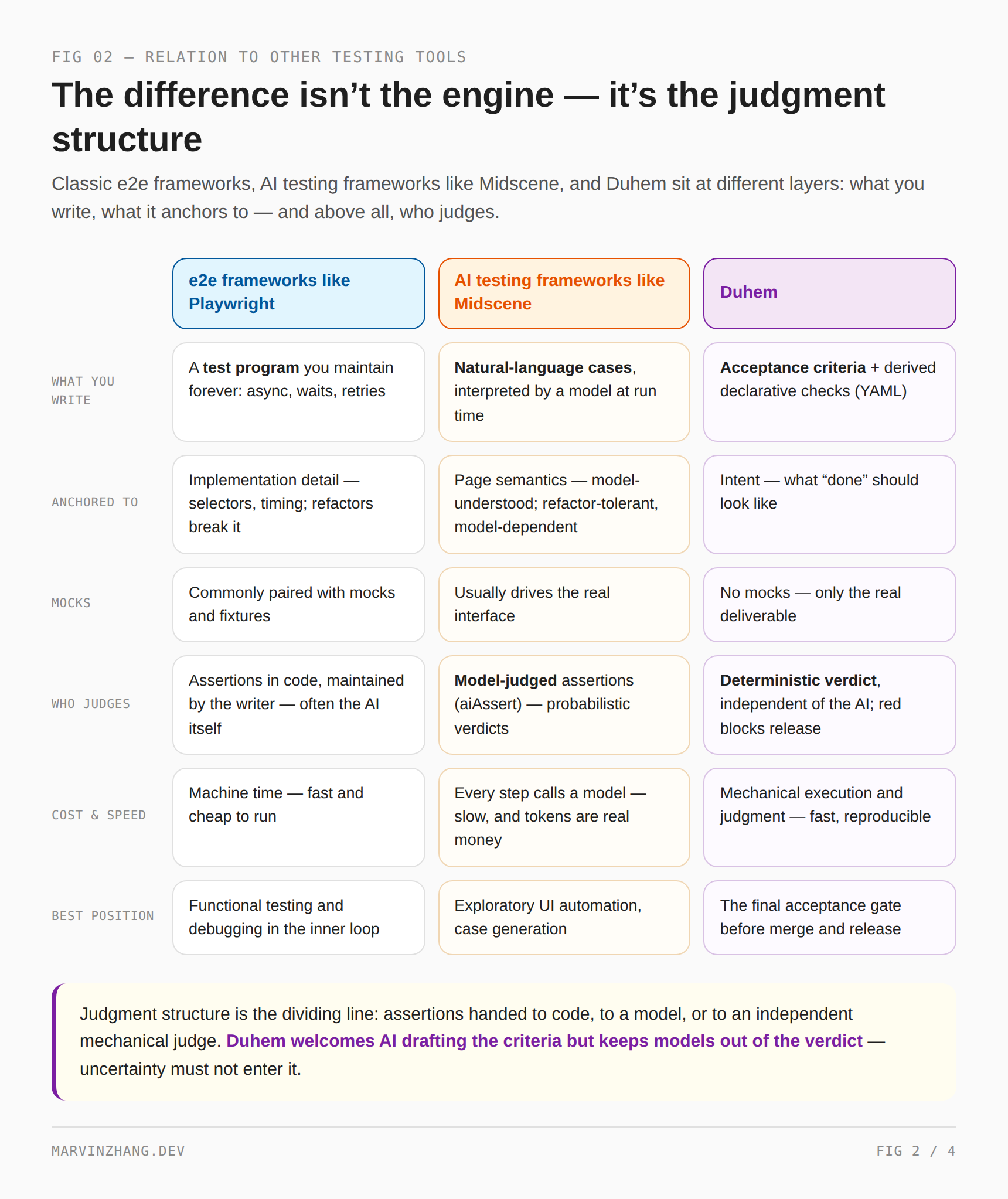
First, a temptation to resist: don't rank Duhem on how few characters it takes. I fell for it — measured the VD against Crawlab's real login acceptance — and the result is boring. At equal coverage a VD runs a bit longer than an idiomatic Playwright spec, and the difference is mostly that the VD carries its environment declaration (environment: up/down) inline while Playwright hands that to a docker-compose, a global-setup, and CI config — none of which show up in the test file, all of which you still write and maintain. Count it all and the two are the same order of magnitude; whichever is slightly longer is noise. (Measuring the character count did have one payoff: it surfaced a real DX defect in Duhem itself — every assert step dragged a boilerplate triplet. We fixed it, onsager-ai/duhem#253, now merged. A blog measurement improving the product is exactly what dogfooding is for.)
Character count is the wrong ruler. As agents take over more of the writing, verifying, and fixing, three other things are what actually matter:
- Stability. Duhem's verdict is deterministic: same input, same conclusion, every time, reproducible. A tool that lets a model judge assertions can't promise that — the same page can pass this run and fail the next. Inside an agent's loop, one probabilistic flip is enough to derail it: it "fixes" a bug that doesn't exist, or trusts a green it shouldn't, and burns cycles retrying.
- Runtime cost. This is the one number that is one-sided, and it favors Duhem: a VD and a classic e2e suite make zero model calls per run; a model-driven test runs a model on every action and every assertion. Inside a gate that fires on every build, that token bill compounds daily.
- Drift resistance. You write what to verify (intent), not how (the program tangled up with selectors and timing). Restructure the DOM or change a selector path and the check's meaning is unchanged, with nothing to edit; even a button-copy change that nudges a
locatortouches how you verify, not what — while a selector-coupled test breaks on every refactor.
As for the bit of extra length the VD carries — that plain-language statement of what "done" means — it isn't overhead, it's the payload. An agent iterating needs the definition of done to begin with; Duhem writes it into the verification, where with Playwright the agent has to reverse-engineer it from imperative code. The VD is a little bigger precisely because it carries the most valuable thing on its back.
So in the agent-native era, Duhem's position isn't just "the last gate": it's the non-drifting anchor in the agent's feedback loop — the anchor does move, but only deliberately with requirements, never passively with the implementation; stable, carrying its own intent, with a verdict that carries no probability. Keep the inner-loop tests, keep the AI-driven exploration; but the "truth" an agent iterates against needs to live on an anchor like that.
The first real bug it caught
In mid-July 2026, a :edge image build of Crawlab Pro — our web-crawler management platform — was stopped by its Duhem acceptance suite: the web front wasn't reachable.
The cause was well hidden. The new image was missing a system package, so envsubst — the small utility that renders the nginx config template — didn't exist. A shell redirect in the startup script first truncated the build-time nginx config to an empty file; then the envsubst: not found error was swallowed by an || true. nginx loaded an empty config and fell back to its defaults — nothing listened on the port it should have served: the UI was unreachable and the /api reverse proxy was gone.
Here's the part worth dwelling on. The backend process was completely fine. And the container's own health check — the signal Docker and Kubernetes use to decide "is this thing alive?" — reported healthy the whole time, because it checked a health-status file the backend was still dutifully writing, not the entrance users actually go through. Every automated signal the image shipped with was green; the one thing broken was the only path users take.
Duhem's verdict was red, for a plain reason: following the acceptance criteria, it walks the same path users do — open the front, log in, call /api — and if that path doesn't work, it doesn't pass. And a red verdict is nothing mystical — it's just the output of a duhem run, laying out which criterion, which assertion, and actual-versus-expected:
$ duhem run .duhem/regression
fail
  AC-1::AC-1.1:
    fail  $steps.front.outputs.status == 200
        (actual 404, expected 200)
actual 404, expected 200 — the page the front should have served was gone, and nginx's default backend answered with a 404 instead. No stack trace, no guessing: "on the path users take, expected 200, got 404." After installing the missing package and making the render script swap the config in only on a successful render, the same command runs green:
$ duhem run .duhem/regression
pass
Afterward we changed the gate from manually triggered to running automatically after every :edge build — a green verdict is now the hard precondition for an image to promote to :stable and reach any user:
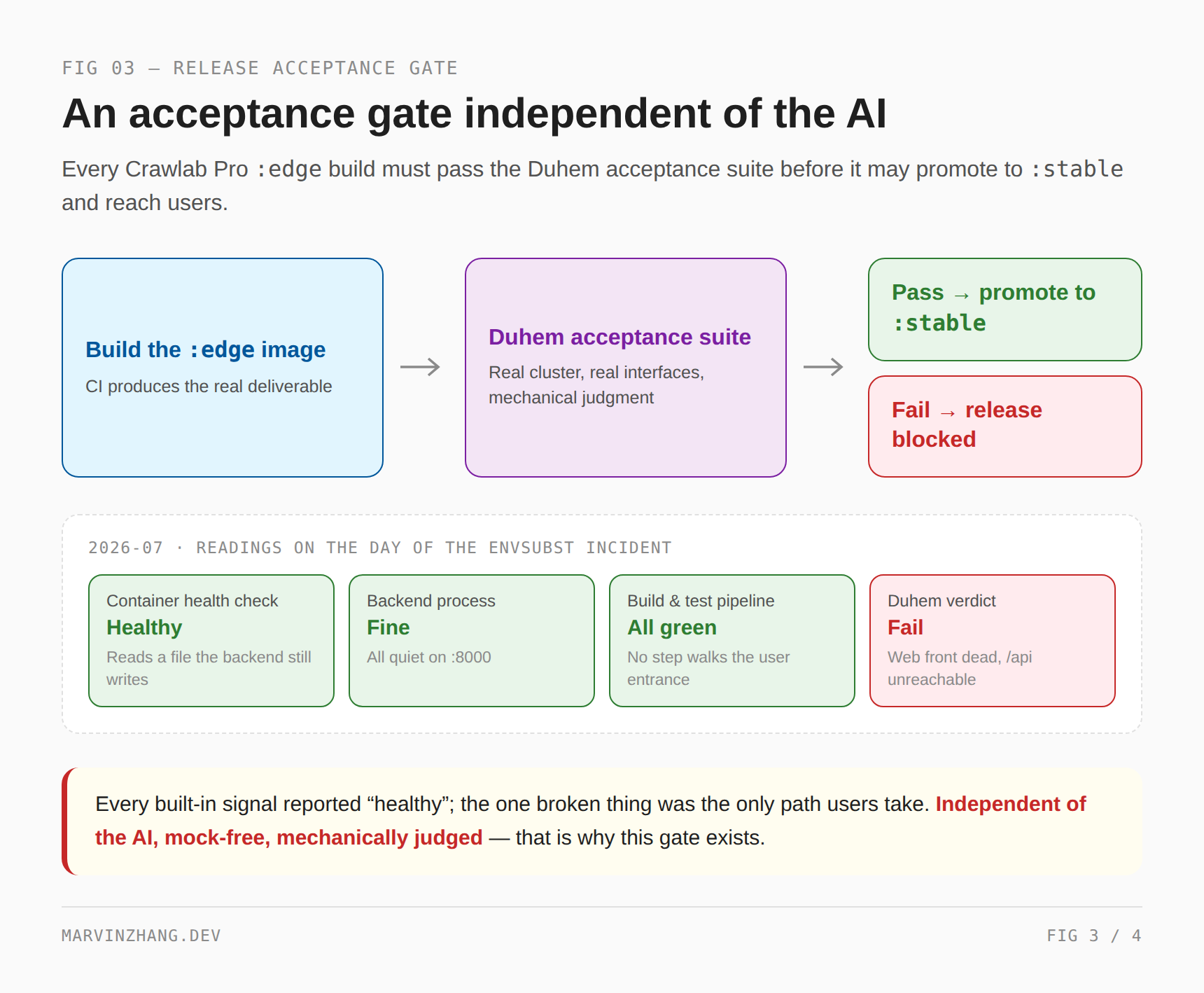
Back to the question in the title: in this incident, trusting the "pass" from the AI and the system's own signals would have shipped that image. It didn't ship — not because anyone was more careful, but because an acceptance gate stood in the way: independent of the AI, mock-free, mechanically judged.
The difference shows up when an agent maintains it
Catching a disaster is the dramatic case. But most of the time you're not catching disasters — you're changing things, and increasingly the one doing the changing is an agent. It's in that everyday act that a VD and an imperative test really diverge.
Hand an agent the same two changes: an implementation change (button copy from "Sign In" to "Log in") and a requirement change (now reject an empty password).
In Playwright both are edits to the same imperative code. Intent has no home of its own, so the agent reconstructs "what is this actually verifying?" from selectors and assertions — and it can get that wrong. Its most dangerous move: to make a flaky case go green, it quietly loosens an assertion (getByRole('button', {name:'Sign In'}) becomes getByRole('button')). The test still passes, the coverage is silently gone, and nobody notices. That's not hypothetical — Duhem's own history has one: a too-loose assertion that stayed green while failing to actually verify a destructive write.
In a VD, the two changes land in structurally different, typed places: an implementation change touches only the check's locator; a requirement change adds a criterion with a description. So a diff is self-classifying — you can read it and tell whether the promise moved.
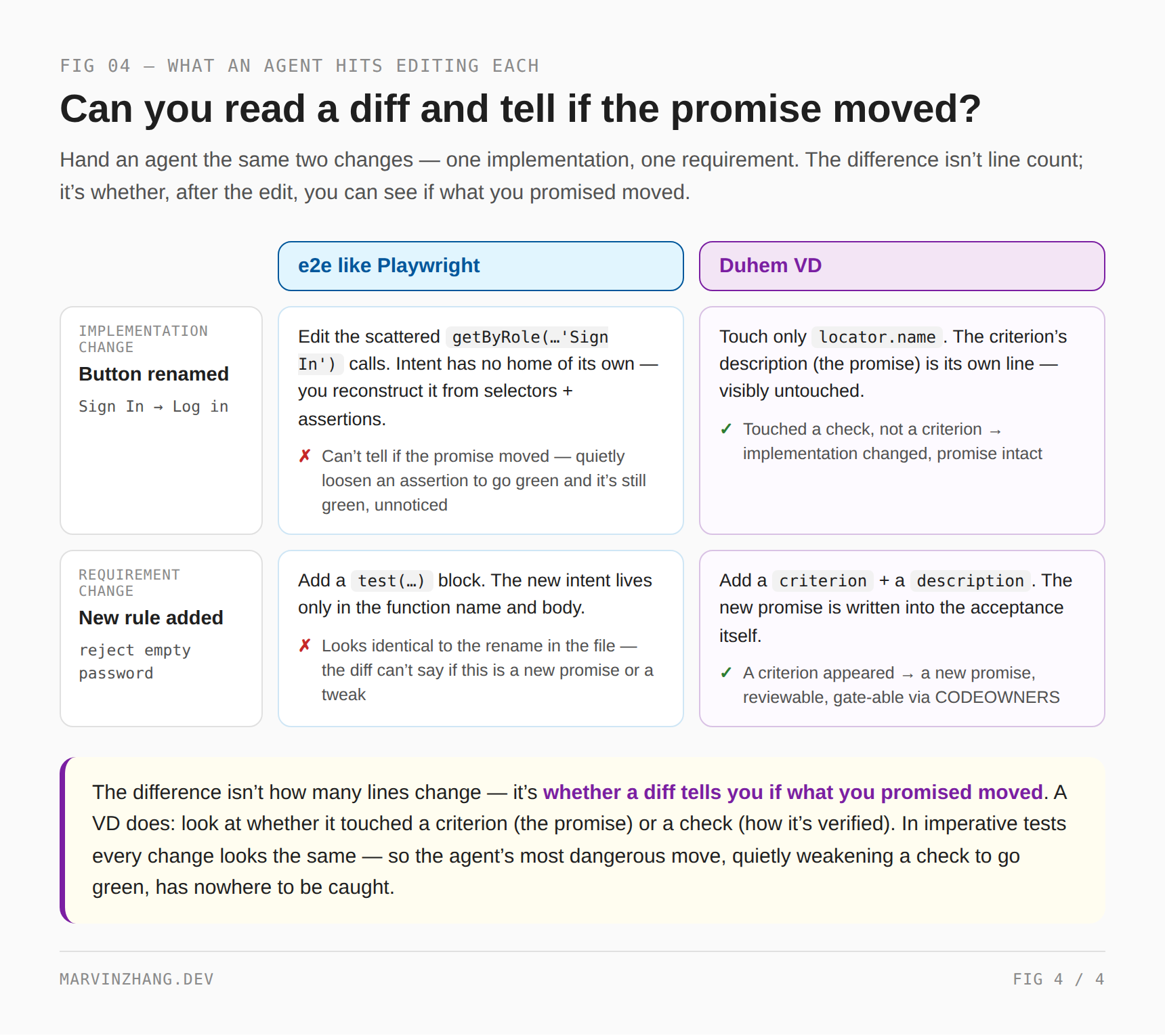
In fairness, this isn't free. A VD only protects intent if the description is written as intent, not implementation copied in ("the button labeled Sign In") — Duhem makes the separation structural, but it can't force you to word it well. And a disciplined Playwright suite (page objects, clear test names) carries intent too. The real difference is structure vs. convention: Duhem builds the split between "the promise" and "how it's checked" into the skeleton; Playwright leaves it to the team's discipline. And when more of the editing is done by agents, convention erodes the way it does with people — the part written into the structure is the part you can rely on.
Why "Duhem"
The name comes from the philosopher of science Pierre Duhem, who argued — in what later became known as the Duhem–Quine thesis — that no scientific hypothesis can be tested in isolation: what gets tested is always the whole web of theory, instruments, and auxiliary assumptions. AI-delivered software is the engineering instance of that thesis: when an agent ships a feature, what's actually delivered is the combination of code, prompts, tool configuration, data state, and runtime — and any one strand can break the whole, like that missing envsubst. That's why verification has to be holistic, and why "no mocks" is a design principle rather than a preference.
Duhem is open source under Apache-2.0 and currently v0.x — the schema will still see breaking changes, and we'll provide migration paths. It already runs daily on our own products: Crawlab Pro's release acceptance gate, and Duhem's self-verification of its own contract.
Getting started
# install (npm; prebuilt binaries also on GitHub Releases)
npm i -g duhem

# scaffold a Verification Definition (the default check needs no browser),
# validate it, then run it end-to-end
duhem init ./verifications/sample --name sample
duhem validate ./verifications/sample/duhem.yml
duhem run      ./verifications/sample
Prebuilt binaries are on GitHub Releases; the getting-started guide walks you from zero to authoring your first check. Browser-driven (ui/*) checks additionally need a one-time duhem browser install.
Looking for a few people to try it on real systems
Last week's Why AI Agent Teams Can't Escape the Mythical Man-Month listed verification standards among the scarce crafts of the agent era; Duhem is an attempt to turn that craft into infrastructure.
Duhem fits systems that are business-critical, structurally complex, and still evolving — where a silent regression is expensive and "does it still work?" isn't something you can confirm at a glance. Conversely, prototypes and tools you can eyeball don't need it.
We're looking for a small number of engineering owners building such systems with AI, to shape Duhem with us: you get direct support and a direct line to the people building it; we get the test of real-world use.
If you're interested in Duhem — or in my writing — add me on WeChat at tikazyq1 with a note saying "Duhem" and let's talk directly; you're also welcome to open an issue on the Duhem repo.