
2 posts tagged with "Data Architecture"

Data architecture design and enterprise data modeling

View All Tags

From Workshop to Factory: The Industrialization of Intelligence


· 24 min read
Marvin Zhang
Software Engineer & Open Source Enthusiast

The AWS Summit in Shanghai
The AWS Summit in Shanghai, 23–24 June 2026.

In June 2026, I gave what was almost certainly the least glamorous talk at the AWS Summit in Shanghai. I opened with a disclaimer: our Nova is not the Nova from Amazon. The Nova on my slides is an internal platform my team builds at HP; the Nova everyone else kept name-dropping is Amazon's frontier model. The room laughed at the collision — and then I spent the session on something no keynote would touch: how we moved a reporting stack off Power BI and onto Amazon Athena and Apache Iceberg. It was a thirty-minute, 300-level breakout, upstairs on the sixth floor, well away from the crowds.
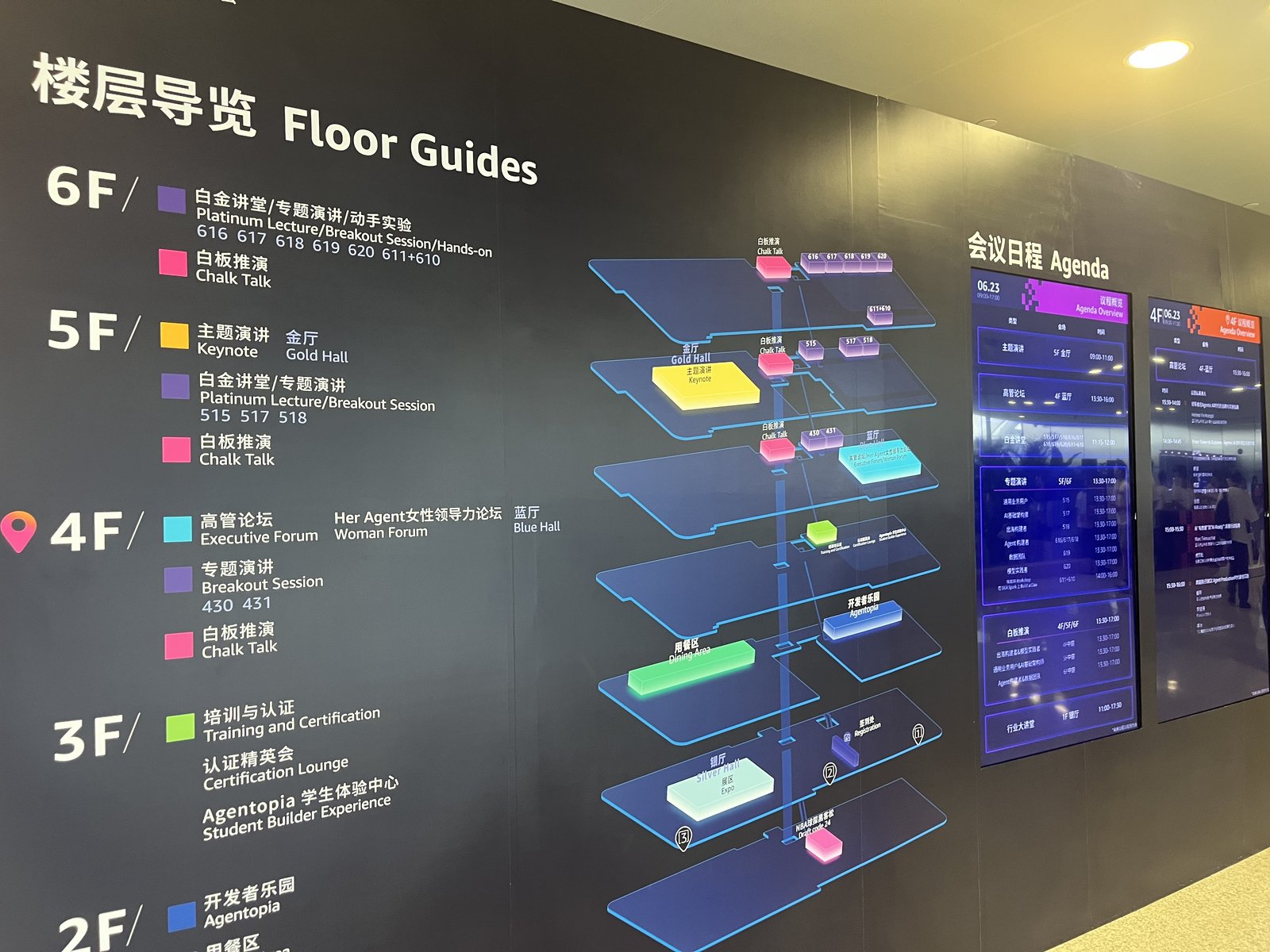
The summit floor guide
The floor guide: breakout talks — mine among them — on the sixth floor, the keynote on the fifth, the expo downstairs.

Down on the ground floor, the expo hall was selling the opposite of unglamorous. Unitree humanoids reached for objects under hot lights. A dexterous robotic hand, priced at ¥9,999, flashed a peace sign for the cameras. On one screen, a swarm of coding agents shipped software with no human in the loop; on another, an AI turned footage of a football match into tactics and player metrics. The spotlight was on intelligence learning to perceive the world, to make things, and to act in it.

The expo floor
Down on the ground floor: the expo, where the crowds were.

That contrast is the argument of this piece. For two centuries, output scaled with headcount: more work meant more hands. AI is breaking that link — output is starting to scale with infrastructure (models, compute, and data) rather than people. This is the industrialization of intelligence, and like the first industrial revolution, it will be won not by whoever owns the flashiest machine but by whoever builds the floor those machines stand on. My boring migration is the proof in miniature: what made our reports better was not a smarter model but a new foundation underneath them — a refresh that once took four to six hours now finishes in one, and a report you could once only read became data anyone can now question in plain language.

So this article works from the floor up. First, the three frontiers the show floor was celebrating — machines that perceive, create, and act. Then the layer beneath all three, the one I went to Shanghai to talk about: the data foundation that decides how high any of them can climb.

From Chatbots to Agents: Building Enterprise-Grade LLM Applications

· 22 min read
Marvin Zhang
Software Engineer & Open Source Enthusiast

Picture this: It's Monday morning, and you're sitting in yet another meeting about why your company's LLM application can't seem to move beyond the demo stage. Your team has built a sophisticated GPT-4o-powered agent that handles complex customer inquiries, orchestrates with internal systems through function calls, and even manages multi-step workflows with impressive intelligence. Leadership is excited, budget approved. But six months later, you're still trapped in what industry veterans call "demo purgatory"—that endless cycle of promising LLM applications that never quite achieve reliable production deployment.

If this scenario sounds familiar, you're not alone. Whether organizations are building with hosted APIs like GPT-4o, Claude Sonnet 4, and Gemini 2.5 Pro, or deploying self-hosted models like DeepSeek-R1, QwQ, Gemma 3, and Phi 4, the vast majority struggle to move beyond experimental pilots. Recent research shows that AI's productivity benefits are highly contextual, with structured approaches significantly outperforming ad-hoc usage. The bottleneck isn't the sophistication of your LLM integration, the choice between hosted versus self-hosted models, or the talent of your AI development team. It's something more fundamental: the data foundation underlying your LLM applications.

The uncomfortable truth is this: Whether you're using GPT-4o APIs or self-hosted DeepSeek-R1, the real challenge isn't model selection—it's feeding these models the right data at the right time. Your sophisticated AI agent is only as intelligent as your data infrastructure allows it to be.

If you've ever tried to transform an impressive AI demo into a production system only to hit a wall of fragmented systems, inconsistent APIs, missing lineage, and unreliable retrieval—this article is for you. We argue that successful enterprise LLM applications are built on robust data infrastructure, not just clever prompting or agent frameworks.

Here's what we'll cover: how data accessibility challenges constrain even the most capable models, the infrastructure patterns that enable reliable tool use and context management, governance frameworks designed for LLM-specific risks, and concrete implementation strategies for building production-ready systems that scale.

The solution isn't better prompts or bigger models—it's better data foundations. Let's start with why.